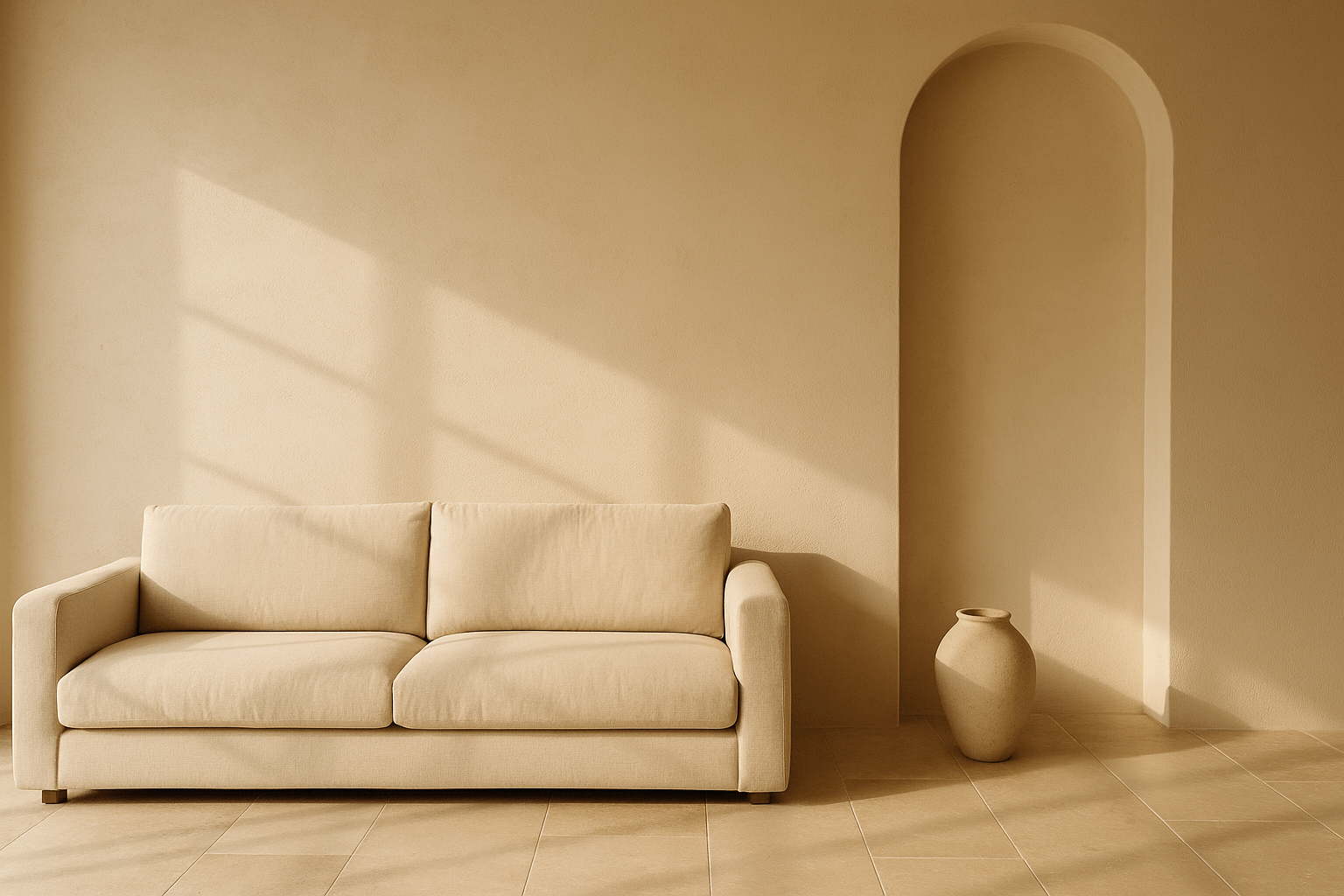
Soft Architecture is not a style in the common sense — it is a position on what a room is for. A room built on this logic does not perform. It does not display its materials or announce its intentions. It does the quieter thing of creating conditions in which the people inside it can settle.
The walls
Plaster, not paint. The difference is substantial. Paint is a coating; plaster is a skin. At different hours of the day, a plastered wall reads differently — in the morning it absorbs light, in the afternoon it catches it, in the evening it glows a little. This variability is not a problem to solve. It is the point.
If you are working with existing drywall, a lime wash is the most honest approximation. Apply it unevenly, let the applicator marks remain. The wall should have a slight memory of how it was made.
The floor
Stone or concrete, both in warm registers. Pale limestone, or concrete mixed warm — not the grey of car parks but something closer to the colour of dry earth. Whatever the material, the floor should read as the heaviest thing in the room. It provides the gravity that allows the rest to be lighter.
If neither is feasible, wide-plank wood in an unfinished or matte finish. Nothing lacquered. The floor should not reflect.
Textiles
Linen throughout, unbleached or very lightly washed. The colour range is narrow: the off-whites, the pale naturals, the tones you would find in a piece of undyed wool left in the sun for a season. Cushions and throws exist to be used, not displayed — they should look as though they have been.
One heavier textile — a blanket, a rug — in a tone slightly deeper than everything else. This gives the room its only anchor point. Without it, the space reads as empty rather than spare.
Objects
The question to ask about any object entering this space: does it belong here, or is it resting here? Objects that belong are ones that connect to the material logic of the room. Ceramics, stone, raw wood, woven grasses. Objects that are merely resting should not be present at all.
One vessel, one light source, one surface. That is enough. More is a different vision entirely.