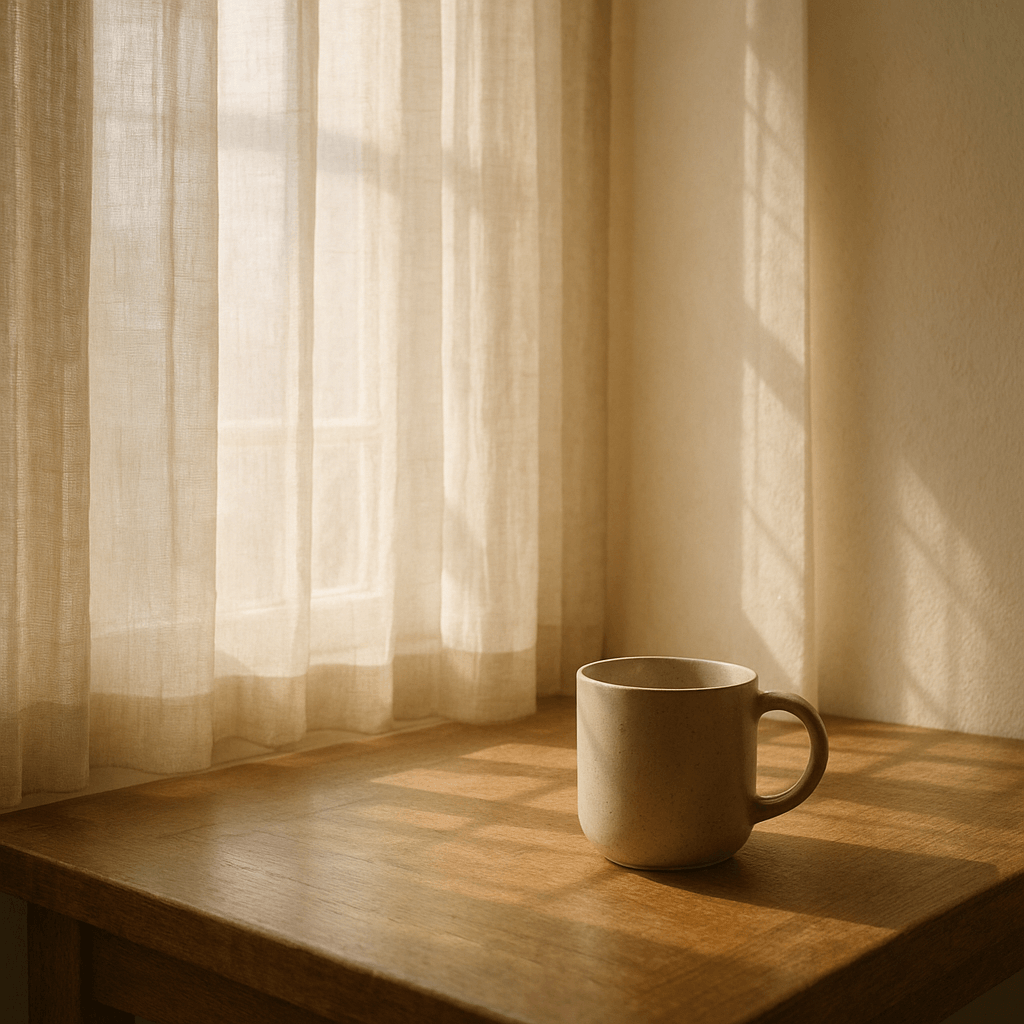
We have spent considerable time thinking about what a room should look like and very little time thinking about what a room should be like at seven in the morning. This is a mistake. The quality of the first hour shapes everything that follows it, and the first hour is almost entirely a spatial experience.
A morning in a well-designed space has a particular quality. It is not that the space is more beautiful — it may not be. It is that the space does not create resistance. The light enters where you need it. The surfaces are clear enough that the first action of the day is not organising or navigating around objects. The temperature is right, or at least the thermal properties of the materials — stone, wood, cotton — make it easier to arrive at the right temperature quickly.
Most of us design our spaces for the middle of the day: for what the room looks like photographed, for what it communicates to guests, for the composed moment. The morning is different. It is personal, imperfect, transitional. Designing for it requires a different set of considerations.
The first is light. Morning light is directional and low; it will enter through specific windows and travel across specific surfaces. If those surfaces are cluttered, the light will illuminate the clutter rather than the room. A single cleared surface near a window — even a small one — can transform the quality of a morning in a way that no furniture purchase can replicate.
The second is material. In the morning, you are in contact with materials before you are fully awake — the floor underfoot, the fabric of your clothing, the surface of whatever you first touch. These first material encounters set the register for the day. Rough concrete underfoot and a plastic kettle in hand is a different register than wooden boards and a ceramic mug. The difference is not about expense. It is about the quality of attention the object asks of you.
The third is sequence. Morning is a sequence of small actions: waking, water, light, warmth, food, thought. The space either supports this sequence or interrupts it. A kitchen designed for cooking efficiency but not for making a single morning cup is interrupting a sequence that happens every day. What does the morning path through your space look like? Does each stage of it make the next one easier?
We returned to this question when designing the Still Life collection — not asking what objects looked good in the abstract, but what objects looked right at seven in the morning, in the particular quality of light that the morning brings. The answers were specific. A ceramic mug that is heavy enough to hold properly. A wooden tray that holds what the morning needs before it is needed. A linen cloth that does not ask to be folded perfectly. Objects that are already on the side of the person who is trying to be present rather than organised.
The light before noon is a particular kind of light. It has a patience to it that the afternoon loses. Designing a space to receive it well is not a minor consideration — it is one of the more consequential design decisions a home can make.