The question of which fabric to use throughout a home is more consequential than it appears. Fabric is what you touch most often. It is the material in most direct contact with the body — bedding, clothing, upholstery, curtains, towels. The choices accumulate. Over time, a home made primarily of linen feels different from one made primarily of cotton or synthetic blends, in ways that are difficult to articulate but immediately perceptible.
We chose linen, primarily, and the choice was not aesthetic first — it was material. Linen is made from flax, which is a more resource-efficient plant than cotton by almost every measure. It uses less water, fewer pesticides, and produces a fibre that is stronger, longer-lasting and more breathable than cotton. These are arguments for using it regardless of what it looks like. The fact that it looks like what it is — a natural, imperfect, honest material — is a further argument.
Linen does several things that cotton does not. It thermoregulates better, which means it is cooler in summer and warmer in winter than an equivalent weight of cotton. It dries faster, which matters for towels and bedding. It resists mildew. It softens with washing in a way that improves rather than degrades the material — a linen cloth washed fifty times is a better linen cloth than the same cloth washed twice.
The difficulty with linen is that it requires a different relationship than cotton. It wrinkles visibly and permanently, and it does not release those wrinkles through hanging or steaming the way cotton does. The choice of linen is partly a choice about what your relationship to wrinkle is. If the wrinkle is a problem, linen will be a constant source of friction. If the wrinkle is understood as evidence of use and life — as something the material does honestly, rather than failing to do — then linen becomes one of the most comfortable materials to live with.
We use it for curtains, bedding, cushion covers, napkins, and kitchen cloths. In each of these applications, the material performs better than the alternatives we considered, and the visual result is of a piece rather than assembled from different registers. A home where linen is consistent has a particular coherence — not because linen is fashionable, but because it is the same material making the same argument in every room.
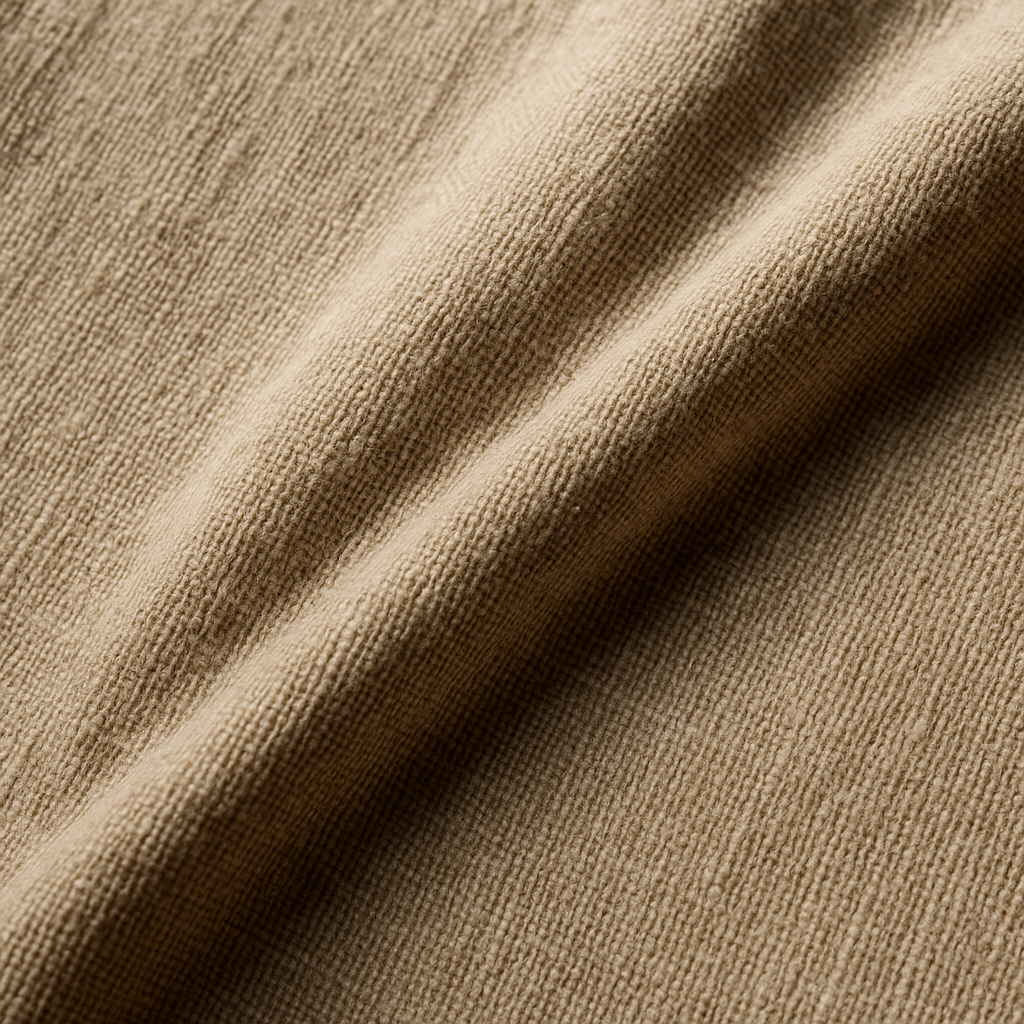
The colour question is simpler than it seems. Unbleached or very lightly washed linen — in the natural flax tones — sits in a palette range that relates well to stone, wood, ceramic and dried botanical materials. It does not fight for attention. In a room that already contains warm stone or pale oak, undyed linen disappears into the background in the best possible way, providing texture without colour.